





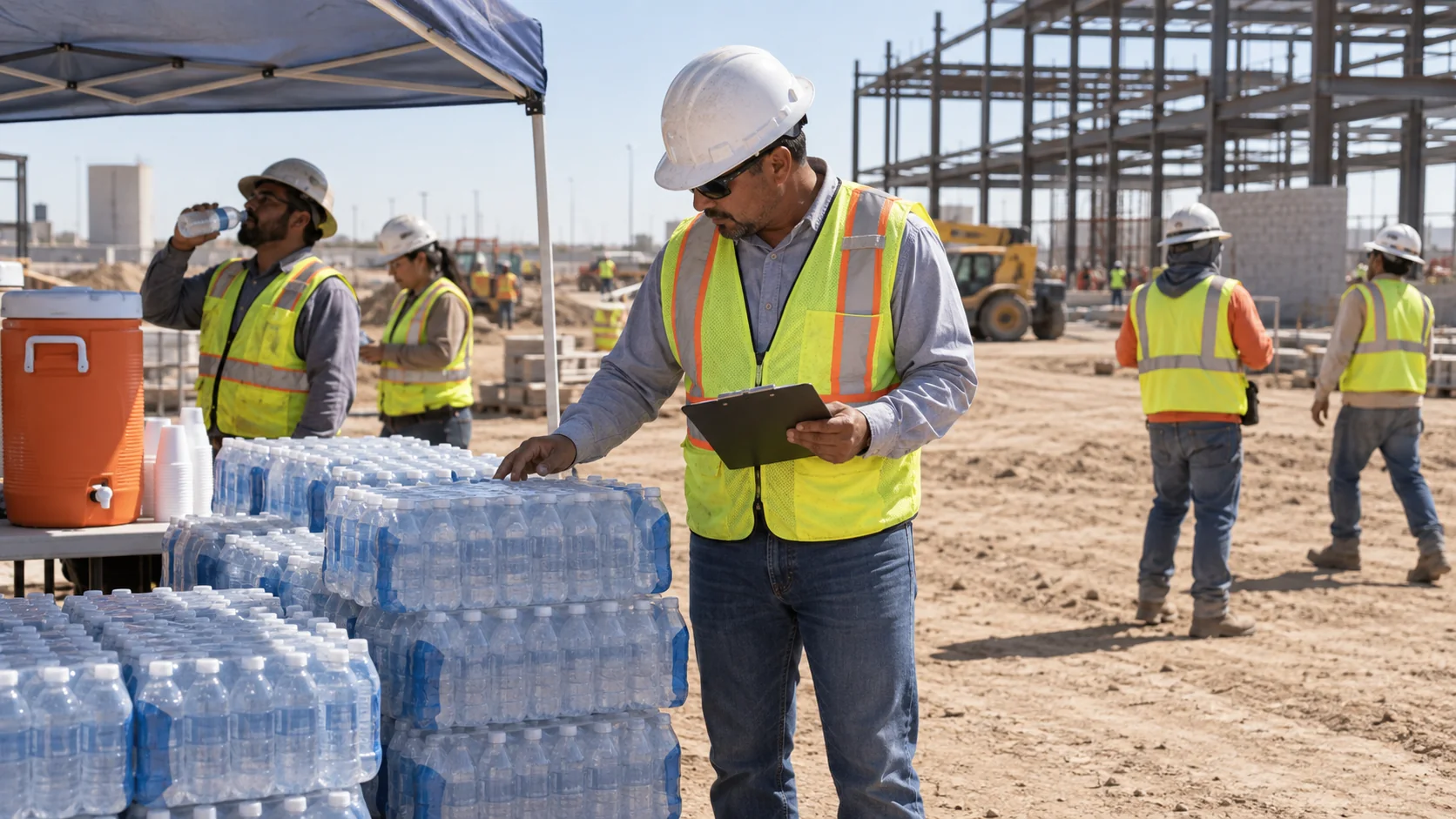
How Many Cases of Bottled Water Does a Construction Crew Need Per Day?
Ordering water for a jobsite should not be a morning guess. Too little creates a safety problem before the shift ends; too much can crowd a trailer, sit in direct sun, or complicate the next mobilization. The simplest plan starts with crew size, hours worked, bottle size, and a reserve.
This calculator is intended for procurement planning, not as an individual medical prescription. Work rate, sun exposure, protective clothing, health conditions, and acclimatization all change what a person may need. OSHA advises employers to provide cool water near the work, encourage frequent drinking, and provide access to electrolyte-containing fluids for work lasting more than two hours. See OSHA's Water. Rest. Shade. guidance.
Step 1: Estimate Bottles Per Worker
OSHA's heat guidance commonly uses one cup, or 8 ounces, every 15–20 minutes while working in the heat. With 16.9-ounce bottles, that works out to a planning range of approximately:
- 8-hour shift: 12–16 bottles per worker
- 10-hour shift: 15–19 bottles per worker
- 12-hour shift: 17–23 bottles per worker
These numbers represent availability for a hot shift. They do not mean every worker should be forced to finish the same amount. Supervisors should encourage regular drinking, watch conditions, and follow the company's heat plan.
Step 2: Convert Bottles Into Cases
Use this purchasing formula:
Crew size × bottles per worker ÷ bottles per case = base case count
Round up to the next full case, then add a 15–20% site reserve for visitors, overtime, spilled or damaged bottles, changing weather, and a delivery that arrives later than planned.
- 10 workers, 10 hours: 150–190 bottles, or about 7–8 cases of 24. With reserve, stage 8–10 cases.
- 20 workers, 10 hours: 300–380 bottles, or about 13–16 cases. With reserve, stage 15–20 cases.
- 40 workers, 12 hours: 680–920 bottles, or about 29–39 cases. With reserve, stage roughly 34–47 cases.
For crews at this scale, compare cases or pallet delivery with 5-gallon jugs using our guide to pallet water delivery versus 5-gallon jugs.
Step 3: Adjust for the Actual Site
Increase the starting quantity when crews work in direct sun, wear impermeable PPE, perform heavy labor, work far from the hydration station, or continue through overtime. A newly arrived crew may also require closer monitoring while acclimatizing.
Do not reduce water simply because a night shift feels cooler. Night crews still perform physical work, and every shift needs an accessible supply. Instead, track sealed cases opened and bottles remaining at each shift change for three to five days. That gives purchasing a site-specific reorder point.
Do Not Forget Ice and Electrolytes
Water is more likely to be used when it stays cool and close to the crew. Keep reserve cases shaded, rotate stock, and use clean coolers or a hydration station near the work. For long shifts, plan electrolyte products separately rather than replacing the entire water supply with sports drinks.
Use our construction crew ice calculator to size ice, and review how to set up a jobsite hydration station for placement and restocking.
Build a Standing Water Order
A dependable order should state crew count, shift schedule, bottle or jug preference, delivery location, gate requirements, storage space, and the person who can receive the load. Fastlane Ice delivers bottled water, bagged ice, merchandisers, Gatorade, and Sqwincher across West Texas and Southeast New Mexico.
Request a jobsite hydration quote with your crew size and shift length, and we will help translate the estimate into a practical delivery schedule.