





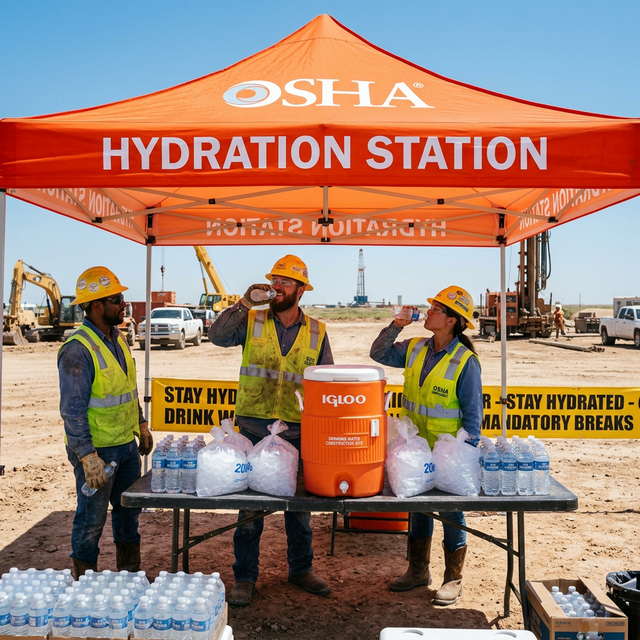
OSHA Heat Illness Prevention: Employer Hydration Requirements in Texas
In the Permian Basin, summer temperatures routinely exceed 100°F — and for industries like oil and gas, construction, and event management, heat-related illness isn't just a risk, it's a constant threat. Every year, dozens of workers in West Texas and Southeast New Mexico are hospitalized due to heat stroke, heat exhaustion, and severe dehydration. Most of these incidents are preventable.
As an employer operating in Midland, Odessa, Pecos, Monahans, Carlsbad, or Hobbs, understanding your OSHA obligations for heat illness prevention isn't optional — it's critical to protecting your workforce and your business.
What Does OSHA Require for Worksite Hydration?
Under the Occupational Safety and Health Act's General Duty Clause (Section 5(a)(1)), employers are required to provide a workplace free from recognized hazards — and extreme heat is one of the most recognized hazards in Texas. While OSHA doesn't yet have a single federal heat-specific standard, the agency actively enforces heat illness prevention through its National Emphasis Program (NEP) on Heat, launched in 2022 and expanded annually.
OSHA's guidelines require employers to:
- Provide potable water — cool, clean drinking water must be available at no cost and located within easy access of all workers. OSHA recommends at least one quart (32 oz) of water per worker per hour.
- Encourage frequent water breaks — workers in high-heat environments should drink at least 8 ounces every 15–20 minutes, even when not thirsty.
- Provide shade or cooling areas — rest areas with shade must be available for workers showing signs of heat stress.
- Implement an acclimatization plan — new and returning workers must be gradually exposed to heat over a 7–14 day period.
- Train supervisors and workers — all personnel must be trained to recognize heat illness symptoms and respond appropriately.
Texas-Specific Regulations: What You Need to Know
Texas made national headlines in 2023 when it passed HB 2127, which preempted cities from passing local heat protection ordinances — including Austin and Dallas's mandatory water break laws for construction workers. However, this does not remove federal OSHA obligations. Every employer in Texas is still bound by OSHA's General Duty Clause and the NEP on Heat.
In practice, OSHA inspectors in the Permian Basin actively conduct heat-related inspections during the summer months (May through September), particularly at:
- Oil and gas drilling and production sites
- Pipeline construction crews
- Commercial construction sites
- Outdoor event venues and setup crews
- Agricultural operations
Penalties for heat-related violations under the General Duty Clause can exceed $16,000 per violation, and willful violations can reach $161,000+. If a worker death occurs, criminal prosecution is possible.
The Real Cost of Non-Compliance
Beyond fines, the cost of a heat-related incident is devastating. A single heat stroke hospitalization can cost an employer:
- $40,000–$100,000+ in medical costs and workers' compensation
- Lost productivity from the downed worker and the investigation
- OSHA investigation and potential shutdown of the affected worksite
- Reputational damage that affects future contract bids
Compare that to the cost of proper hydration — a few hundred dollars per month for scheduled water delivery and ice delivery to your site. The math is simple.
How to Build a Compliant Hydration Program
Building an OSHA-compliant hydration program doesn't need to be complicated. Here's a practical framework used by companies across the Permian Basin:
- Calculate your water needs: Plan for at least 1 quart per worker per hour. A 20-person crew working 10-hour shifts needs approximately 50 gallons of water per day.
- Set up multiple hydration stations: No worker should be more than a 2-minute walk from water. Use coolers with ice at every station.
- Supplement with electrolytes: Water alone isn't enough in extreme heat. Provide Gatorade, Sqwincher, or similar electrolyte products to replace lost sodium and potassium.
- Schedule regular deliveries: Running out of water mid-shift is both dangerous and a compliance violation. Set up a recurring delivery schedule with a reliable provider.
- Document everything: Keep logs of water deliveries, break schedules, and training sessions. This is your best defense in an OSHA inspection.
How Fastlane Ice Keeps You Compliant
Fastlane Ice provides bulk water delivery, bagged ice delivery, and electrolyte products like Gatorade and Sqwincher to worksites across Midland, Odessa, Pecos, Monahans, and throughout the Permian Basin into Southeast New Mexico.
Our scheduled delivery service ensures your hydration stations are always stocked — so you're never caught without water during an OSHA inspection or, more importantly, when your crew needs it most. We work with oil and gas companies, construction firms, and event organizers who need a dependable partner for heat season.
Contact us today to set up a compliant hydration delivery schedule and keep your workforce safe all summer long.